Gel Ball Legal Wars: Dart Zone Emerges (Kinda) Victorious?
December 22, 2025It’s been a while since I last wrote about the legal fight over gel blasters. Since then, the case has been largely slow-moving. Finally, though, there’s a final determination…and Prime Time Toys won! It may be somewhat of a Phyrric victory, though. Let’s take a peek.
Catching Up: The Inter Partes Review and the Final Decision
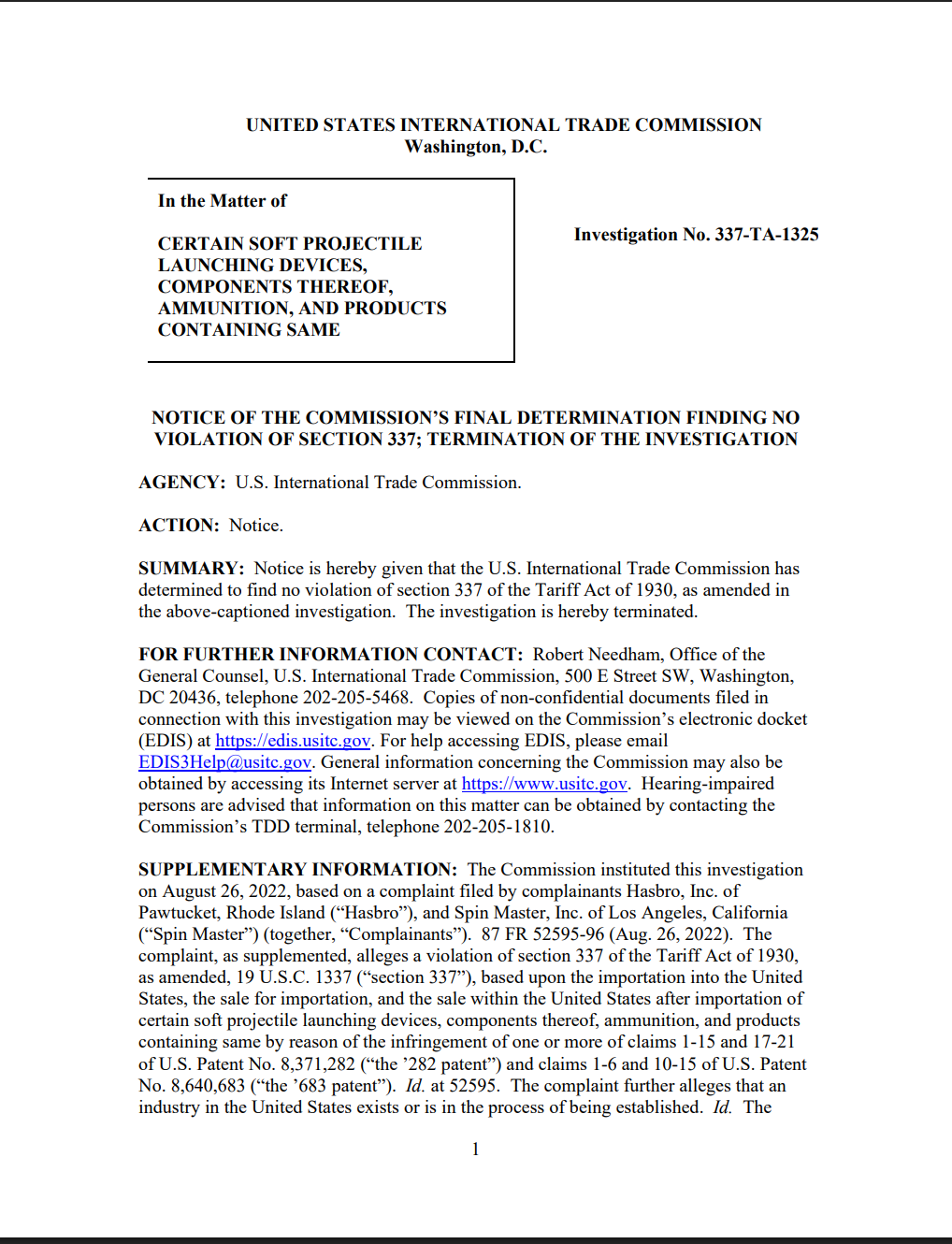 As previously detailed, Hasbro and Spin Master (who owns the patents in question) filed for a Section 337 Investigation for unfair trade and import practices against a domestic industry. Namely, against Hasbro’s plans to release the Nerf Pro Gelfire line. After an initial look, the United States International Trade Commission decided there was enough evidence to warrant investigation, and things went from there. Both as to whether an IP violation occurred, and whether there was a domestic industry being harmed by it (both parts are necessary for the process).
Prime Time Toys was left alone in this fight once Hasbro and Spin Master were able to settle with all the other defendants (Gel Blaster, Splat-r-ball, etc.), presumably with licensing/royalty agreements. There was a final initial determination (ID) against Prime Time Toys in the matter, but further action on the case was largely paused as PTT challenged the patent itself through the Patent Office (a separate process). That followed largely the same arguments as within the USITC investigation, which ended up not convincing the US Patent Office to invalidate the patents.
However, there was another matter that the USITC looked into: whether there was a reason to look at evidence post-complaint as to the matter of a domestic industry existing.
In the Final Determination (337-1325 Final Determination), that appears to have been very important. In the end, the Commissioners voted that a 337 violation did NOT occur; they reversed the Final ID’s determination that a domestic industry was in the process of being established. They still found PTT to be unsuccessful in arguing against patent violations, but with only one of two conditions met, the USITC terminated the case. In essence, they said that this was the wrong forum for handling this case.
What Does All This Mean?
 Admittedly, take my research with a grain of salt, I’m not a legal expert. I’m just doing the best I can to accurately parse out what things mean.
As far as the USITC is concerned, Prime Time Toys doesn’t have to face any sanctions, make some sort of restitution to Hasbro/Spin Master, or be forced to to licensing. That, of course, doesn’t mean that Hasbro couldn’t file a regular lawsuit should Prime Time Toys sell gel ball blasters in the future…but since they stopped selling these on shelves, that’s largely a moot point and a waste of everyone’s resources, including the court. Likewise, PTT could conceivably argue in a federal lawsuit that Hasbro misused the process and seek damages…but at this point that may also be a waste of time.
I’m also not sure what could be done as far as Hasbro appealing this decision is concerned – I believe things would escalate directly to the US Court of Appeals for the Federal Circuit.
Nevertheless, the Section 337 mechanism is the one meant to relatively quickly stop outside imports compared to regular lawsuits, and it had that effect regardless of who “won” in the end. Facing the juggernaut that is Hasbro, all other named companies that wanted to keep selling gel ball blasters settled with Hasbro rather than facing a sudden stop of importation and sales – and since they chose to settle instead of fight, they’re stuck with their decision. Crosman dropped blasters completely, even before their assets got sold off and they closed the manufacturing plant in New York. And Prime Time Toys, the supposed winner here, may not even want to jump back into the market, assuming they can. After all:
- Companies like Xshot have flooded many shelves with their product lines at inexpensive price points.
- Stores like Walmart have sealed away gel ball blasters in the Sporting Goods section, away from toys in general.
- Ongoing regulatory changes, between Consumer Product Safety Commission warnings and ASTM standards being put in place, will affect the market in additional, unforeseen ways.
- Trying to re-enter a market that’s already full of major players may simply be a waste or time and resources, especially given limited amounts of inventory and/or shelf space.
For now, I’ll just have to wait to see if a public version of the Commission’s Opinion is released (the initial version will always be confidential, pending redactions of proprietary company information, etc.). That may shed more light onto how the issue was resolved after months of voting to postpone the decision.